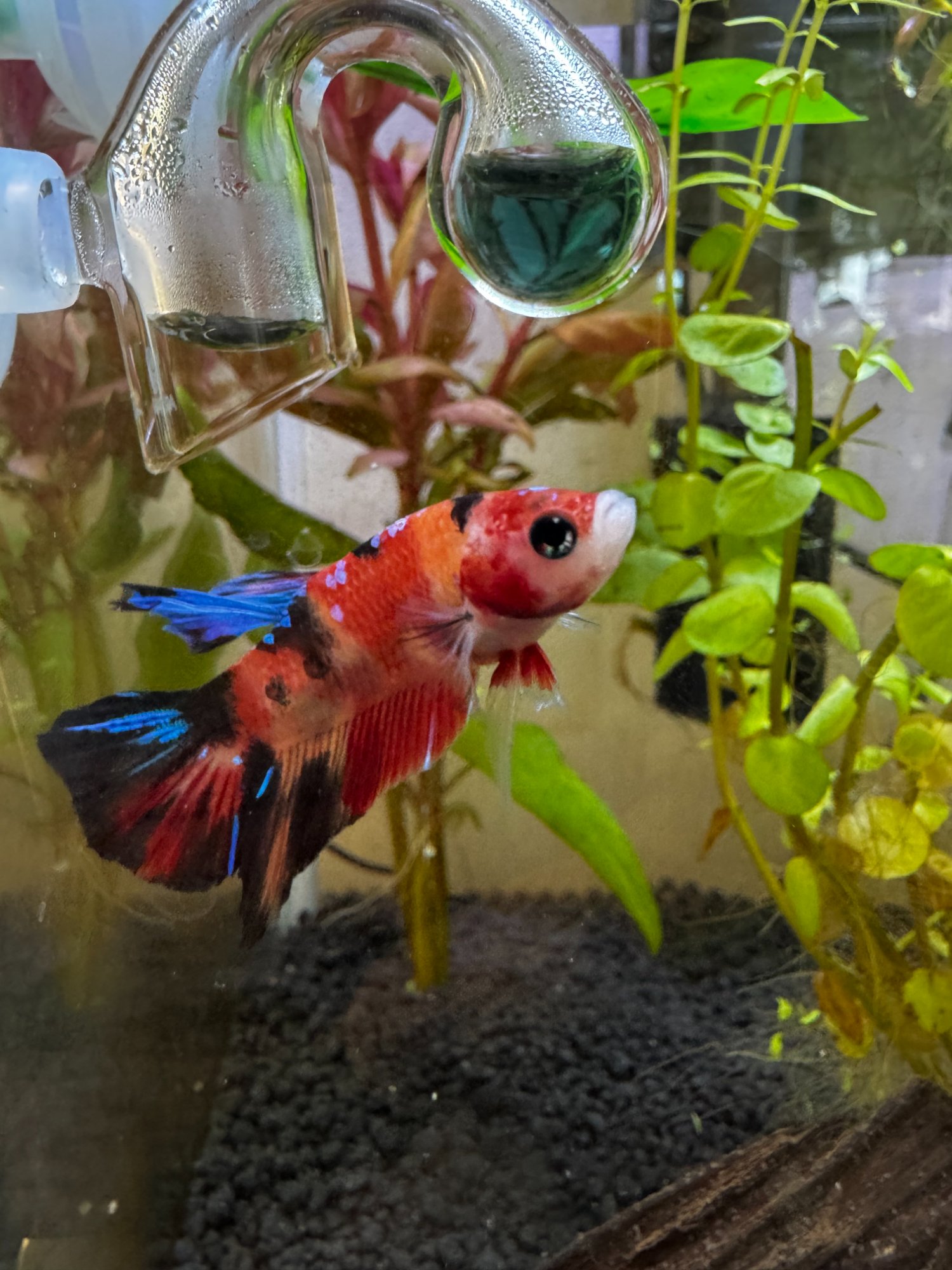
This is Luna-Bel
This is my plakat halfmoon koi betta. His name is Luna or Luna-Bel
My Betta Luna
Meet Luna-Bel 🐟
Luna-Bel is a beautiful Plakat Halfmoon Koi Betta (Betta splendens), a modern ornamental variety of one of the world's most fascinating aquarium fish.
With her striking Koi coloration and distinctive Halfmoon tail, Luna-Bel carries hundreds of years of history in a tiny, colourful body. Although she looks very different from her wild ancestors, she still has many of the behaviours and instincts that made bettas so special to the people who first kept them.
🌏 Where Did Luna-Bel Come From?
Luna-Bel's species, Betta splendens, originates from Southeast Asia, particularly Thailand and the surrounding regions. Wild bettas live in warm, shallow and often slow-moving waters such as rice paddies, ponds, marshes, canals and flooded plains.
Hundreds of years ago, these fish looked nothing like Luna-Bel.
Wild Betta splendens were generally smaller, short-finned fish with subdued brown, green and reddish colours. Their natural environment was filled with vegetation, where their compact fins helped them move quickly through the water.
Over generations, people in what is now Thailand began collecting and breeding them.
And that's where the story of the modern Betta really begins.
⚔️ From Fighting Fish to Living Artwork
The Thai people have a very long history with the Siamese fighting fish, known locally as pla kat, meaning fighting fish.
For centuries, males were selectively bred for strength, stamina and fighting ability. Their territorial nature made them suitable for traditional fish-fighting contests, somewhat similar to the way fighting cocks were bred. Genetic and historical evidence places this domestication hundreds of years in the past, potentially 600–1,000 years ago.
These early breeders were not trying to create beautiful aquarium fish.
They were creating fighters.
The short-finned body of the traditional fighting Betta eventually became known as the Plakat form. The word plakat is associated with the Thai name for the fighting fish.
So Luna-Bel's Plakat heritage connects her directly to this ancient lineage.
🌸 How Did Bettas Become So Colourful?
As Bettas became popular around the world, breeders began selecting them for something very different:
Beauty.
Instead of breeding primarily for aggression and endurance, breeders began selecting fish with unusual colours, patterns, larger fins and distinctive tail shapes.
Over generations, selective breeding produced an incredible range of modern Bettas. Researchers describe Betta splendens as an extraordinary example of how humans have shaped a species through selective breeding, producing enormous variation in colour, body shape, fin shape and behaviour.
And eventually, varieties such as Halfmoons and Koi Bettas emerged.
🌙 Why Is Luna-Bel a Halfmoon?
The Halfmoon refers to the shape of the caudal, or tail, fin.
When Luna-Bel flares her fins, the tail can spread into a beautiful 180-degree fan shape, resembling a half moon.
This is very different from her Plakat ancestry, which traditionally has much shorter fins.
So Luna-Bel is essentially a combination of two very different characteristics:
- Plakat — short-finned body type and strong, athletic appearance
- Halfmoon — spectacular tail spread
- Koi — mottled, multi-coloured patterning
The result is a Betta that combines the strength and compact form of the traditional Plakat with the dramatic appearance of modern ornamental Bettas.
🎨 What Makes a Koi Betta Special?
The word Koi refers to Luna-Bel's colour pattern rather than a separate species.
Koi-pattern Bettas are bred for irregular patches and combinations of colours that can resemble the patterns seen on Japanese Koi carp.
A Koi Betta may display combinations of:
- 🤍 White
- ❤️ Red
- 🖤 Black
- 🧡 Orange
- 💙 Blue
- ✨ Metallic or iridescent scales
One particularly interesting characteristic of some Betta colour genetics is that their patterns can change as the fish grows. Marbling and other colour-changing traits can make individual Bettas look noticeably different at different stages of their lives.
So Luna-Bel's appearance isn't necessarily completely fixed.
She may continue to surprise you.
🫧 Luna Can Breathe Air!
One of the coolest things about Bettas is that they have a special organ called a labyrinth organ.
It allows them to take oxygen directly from atmospheric air at the surface of the water.
This adaptation evolved because their natural habitats can become warm, shallow and low in dissolved oxygen.
That's why you may see Luna-Bel swimming to the surface and taking a little gulp of air.
She's not struggling to breathe.
She's doing something that her ancestors evolved to do thousands of years ago.
🫧 The Bubble Nest
Another fascinating behaviour is the bubble nest.
Male Bettas can create floating clusters of tiny bubbles at the water's surface. When breeding, the male collects fertilised eggs and places them into the nest, then guards them while they develop.
This is one of the reasons Bettas are so fascinating to watch — there is much more going on than simply swimming around an aquarium.
👀 Luna Has a Big Personality
Bettas are famous for being territorial.
A Betta may flare its fins and gill covers when it sees another Betta or even its reflection.
This behaviour comes from the same instinct that made the original Siamese fighting fish famous.
But modern ornamental Bettas are primarily bred for colour and appearance, rather than fighting ability.
So when Luna-Bel suddenly spreads her fins and looks twice her size, she's showing off a behaviour that connects her to her wild ancestors and the traditional fighting Bettas of Thailand.
🇹🇭 From Siam to the World
The story of Betta splendens eventually travelled far beyond Thailand.
The fish became known to Western scientists during the 19th century, and specimens began appearing in European aquariums. By the late 19th and early 20th centuries, Bettas were becoming established in the international aquarium hobby.
The species was eventually given the scientific name Betta splendens.
Interestingly, splendens means splendid or shining.
It's a rather fitting name for Luna-Bel.
🌙 Luna-Bel's Little Place in History
When you look at Luna-Bel swimming around her aquarium, you're looking at the result of a remarkable journey.
Her ancestors were small wild fish living among the vegetation of Southeast Asia.
They became treasured fighting fish in Thailand.
Generations of breeders selected them for strength and character.
Later, breeders around the world began selecting them for extraordinary colours and fins.
And eventually, those different lines produced beautiful fish like Luna-Bel.
She may be only a few centimetres long, but behind those fins is centuries of history, culture, selective breeding and evolution.
❤️ Why Luna-Bel Is Special
Luna-Bel isn't just a pretty aquarium fish.
She's a little piece of living history.
Her Plakat heritage connects her to the traditional Siamese fighting fish.
Her Halfmoon tail represents generations of ornamental breeding.
Her Koi pattern is a modern example of the incredible variety humans have developed through selective breeding.
And her ability to breathe atmospheric air, build bubble nests and display territorial behaviour connects her right back to the wild Betta splendens that lived in the waters of Southeast Asia long before aquariums existed.
🌙 From the rice paddies of Thailand to her home today — Luna-Bel carries a little piece of that history with her.
🐟 Luna-Bel at a Glance
| Feature | Luna-Bel |
|---|---|
| Name | Luna-Bel |
| Species | Betta splendens |
| Common name | Betta / Siamese Fighting Fish |
| Type | Plakat Halfmoon |
| Pattern | Koi |
| Origin of species | Southeast Asia |
| Historical home | Thailand and surrounding regions |
| Special ability | Labyrinth organ for breathing atmospheric air |
| Famous behaviour | Flaring, territorial displays and bubble nests |
| Fun fact | Her colour pattern may change as she matures |